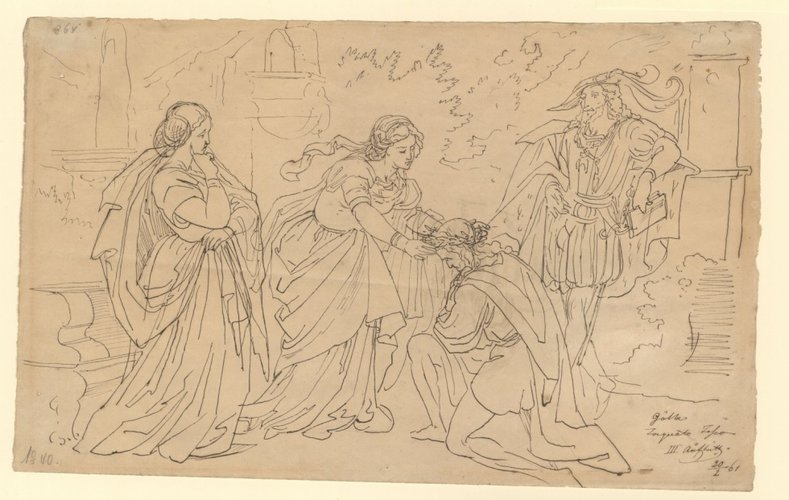
Display case 5: The Homage
The confrontation with antiquity is evident in the pen-and-ink drawing Bekränzung mit Lorbeer [19] (Goethe, Tasso, Act 1, Scene 3): thematically and also stylistically in the outline drawing, and iconographically in the pictorial tradition of homage.
Vogel von Vogelstein took up the competition between the arts, the Paragone, which Gotthold Ephraim Lessing (1729–1781) had discussed Laokoon oder über die Grenzen der Malerei und Poesie (1766). The painter captures a moment of transition – the “fruchtbaren Augenblick” defined by Lessing:
Duke Alfonso II of Ferrara wants to honour Tasso with a crown of laurel leaves from Virgil's marble bust. But the poet Tasso first refuses. The princess's confidante, Leonore is surprised by his movement. Tasso is too modest to allow himself to be equated with Virgil (70–19 BC), the most important poet and epic writer of Roman antiquity. The princess decides to take action. As she raises the crown and speaks:
„Du gönnst mir die seltne Freude, Tasso, / Dir ohne Worte zu sagen, wie ich denke.“
Tasso cannot refuse her any wish:
„Die schönste Last aus deinen teuren Händen / Empfang ich kniend auf meinem schwachen Haupt.“
—
Have you seen it yet?!
The original of the steel engraving [22] is located in our permanent exhibition in the Picture Gallery, just 12 meters away.