Display case 5: The Homage
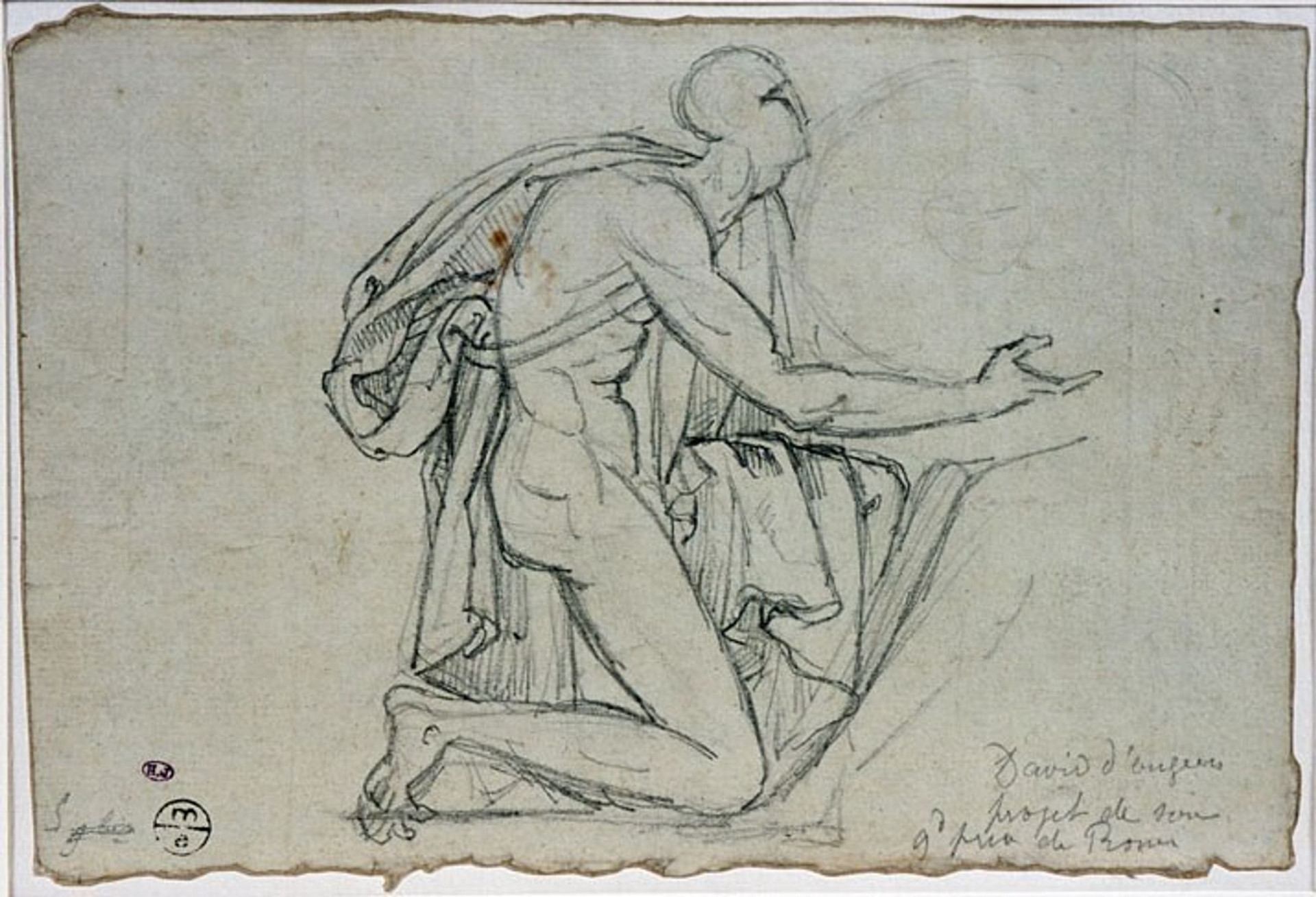
Before David d'Angers created the bas-relief The Death of Epaminondas in clay—as shown in Pajou's painting on the right wall [23]—he first produced sketch drawings. The preparatory detail study [20] and the final drawing [21] give insight into the work's genesis.
The kneeling figure [20] developed from soft to strong contours as the chalk became thicker. The improvements, known as pentimenti, reflect David d'Angers' search for the correct muscle structure. The change in the position of the lower leg and foot is also visible. He marked the shaded areas of the robe with parallel hatching, cross-hatching, and zigzag lines of varying intensity.
The entire drawing [21] shows the shield being handed over to the wounded Epaminondas by his squire after the lost battle. The varying brightness values of the lines indicate the plastic depth gradation: the stronger the relief is to be later, the darker or more precise the contours are. This creates the impression of a three-dimensional structure that transitions from high to low relief. This becomes particularly clear when comparing the figures, the round shield in the middle, and the spears placed behind it.
—
Who was Epaminondas?
Epaminondas (410–362 BC) was a Greek military strategist from Thebes. His victory in the Battle of Leuctra in 371 BC ended the supremacy of Sparta, the army of which had previously been considered invincible. As a commander, he became famous for his so-called oblique order.
He was struck in the chest by a javelin during his third campaign in the Battle of Mantinea (362 BC) in the Peloponnese. The iron tip of the spear could not be removed without immediately killing him. Epaminondas accepted his fate with calmness. He was not concerned about his own life, but rather the outcome of the battle and the rescue of his shield.
David d'Angers captures the moment of decision: the kneeling armour-bearer gives Epaminondas his undamaged shield. It's decorated with the thunderbolt and eagle wings, symbolising divine protection and legitimacy from Zeus, father of the gods. At the same time, he announces his victory. Upon hearing this, a final cheerful smile appears on Epaminondas' face. Then he advises his warriors to retreat and make peace, which they bitterly complain about.
After that, they pull the iron tip out of his chest. Just after that, Epaminondas dies, and Thebes' supremacy in Greece ends.