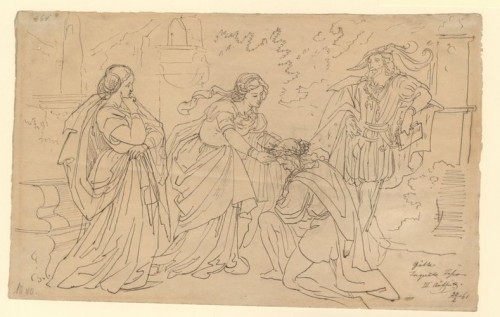
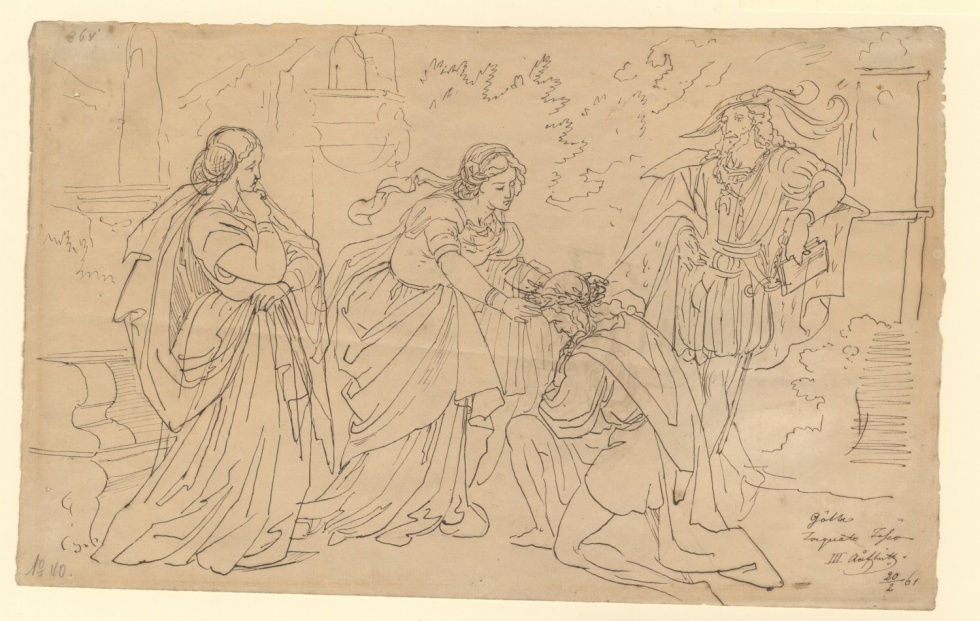
Goethe chose Torquato Tasso (1544–1595), the important 16th-century Italian poet at the court of Ferrara, as the protagonist of his play Torquato Tasso (1790). Goethe's experiences in Italy in 1786/87 are reflected in the drama in an impressive way.
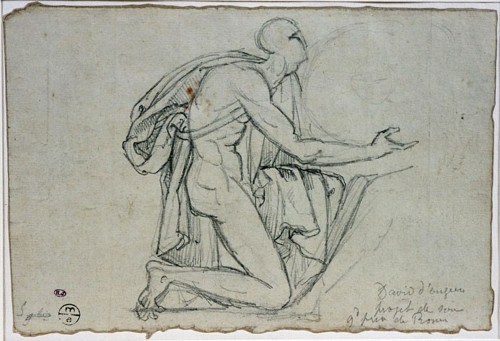
Carl Christian Vogel von Vogelstein was inspired by ancient reliefs, which also served as models for David d'Angers [20, 21], when illustrating Goethe's Tasso [19]. The theme and depiction of both the drama and the personalities – Tasso on one side and Goethe on the other – follow the tradition of ancient Greek laudatory speeches, known as panegyrics.
—
David d'Angers travelled after his stay in Rome, in 1816 to London for the first time. There he studied the Elgin Marbles—the ancient Parthenon sculptures—and visited the studio of sculptor John Flaxman (1755–1826). Parallels to Flaxman's style, which adopts the precise contours of ancient vase painting, can be found in his drawings Tod des Epaminondas [20, 21].
—
Albert Henry Payne produced a steel engraving based on Vogel von Vogelstein's painting Des Malers Atelier (1836) [22]. The image can be interpreted as a portrait of friendship and as a Tribute to the Fine Arts. Portrayed on equal terms are, for example, the painter Vogel von Vogelstein himself, the sculptor David d'Angers, and the writer Ludwig Tieck (1773–1853).