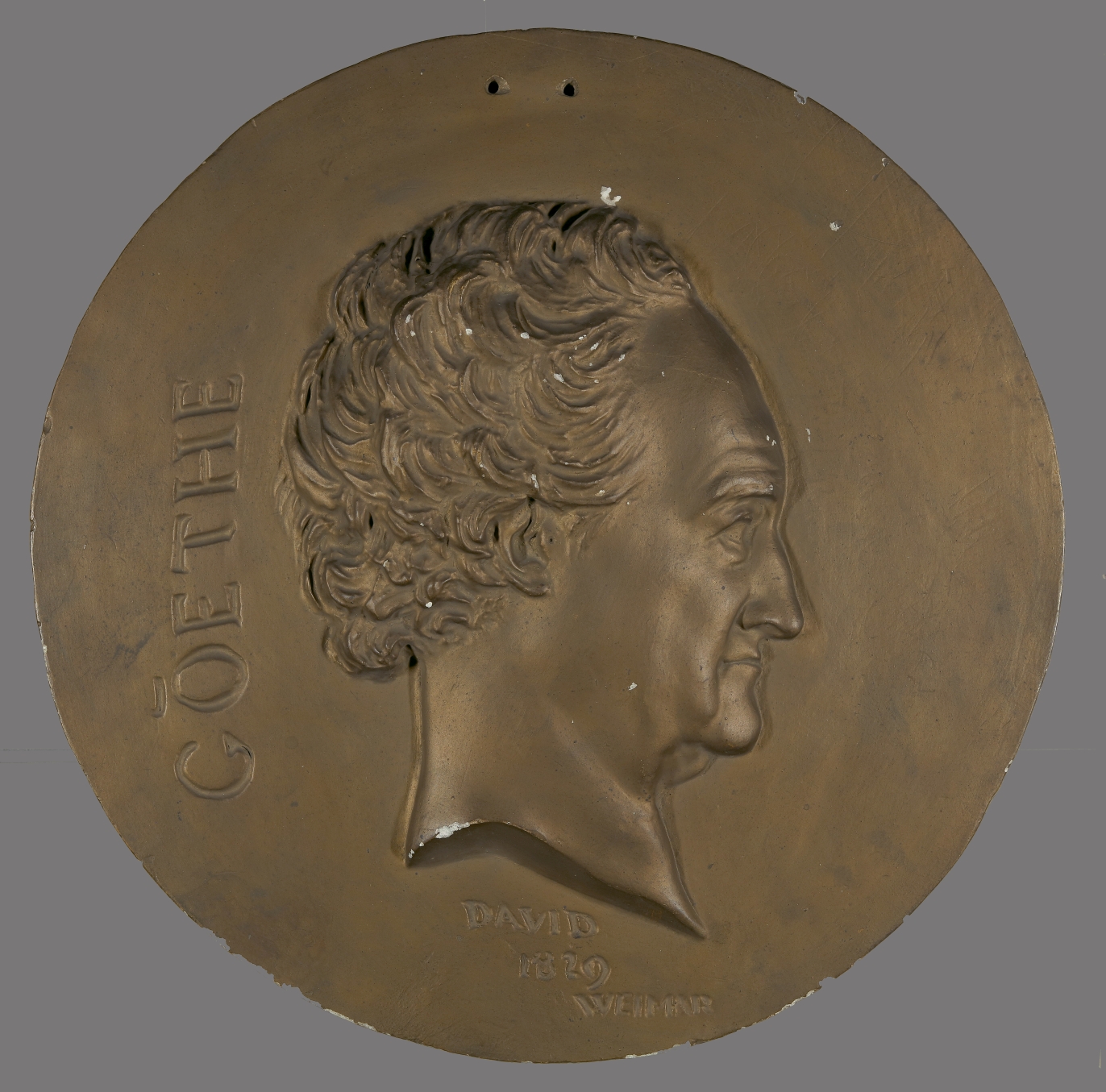
Display case 3: The reproduction
The period during which the bronze medallions of Goethe and Schiller were acquired is documented in the so-called Heuer inventory. Otto Heuer was the director of the Freies Deutsches Hochstift between 1888 and 1925. In 1892, 1893, and 1895, he curated exhibitions on Goethe that were shown in external institutions. In 1897, Heuer founded the first Goethe Museum in Frankfurt and began expanding the art collection in this direction.
—
Ernst Beutler, who was Heuer's successor, bought the Goethe medallion [13] from the Berlin company J. A. Stargardt in 1931. The base plate differs significantly, with a diameter of 31.5 cm, from that of the bronze medallions; the name inscription is also positioned differently. The company catalogue lists the medallion under the number “59a” as “Original gypsum casts [...] One of the rare gypsum casts made in Weimar; the Paris bronze copies were later cast”.
—
The three medallions illustrate the early educational mission of the Freies Deutsches Hochstift. The institution was founded in 1859 on Schiller's 100th birthday and was seated in Goethe's parental home from 1863. From the beginning, the Hochstift aimed to make education available to all. It supported and promoted the arts and sciences, based on the humanistic ideals attributed to the works of Goethe and Schiller.