Display case 2: The story behind its development
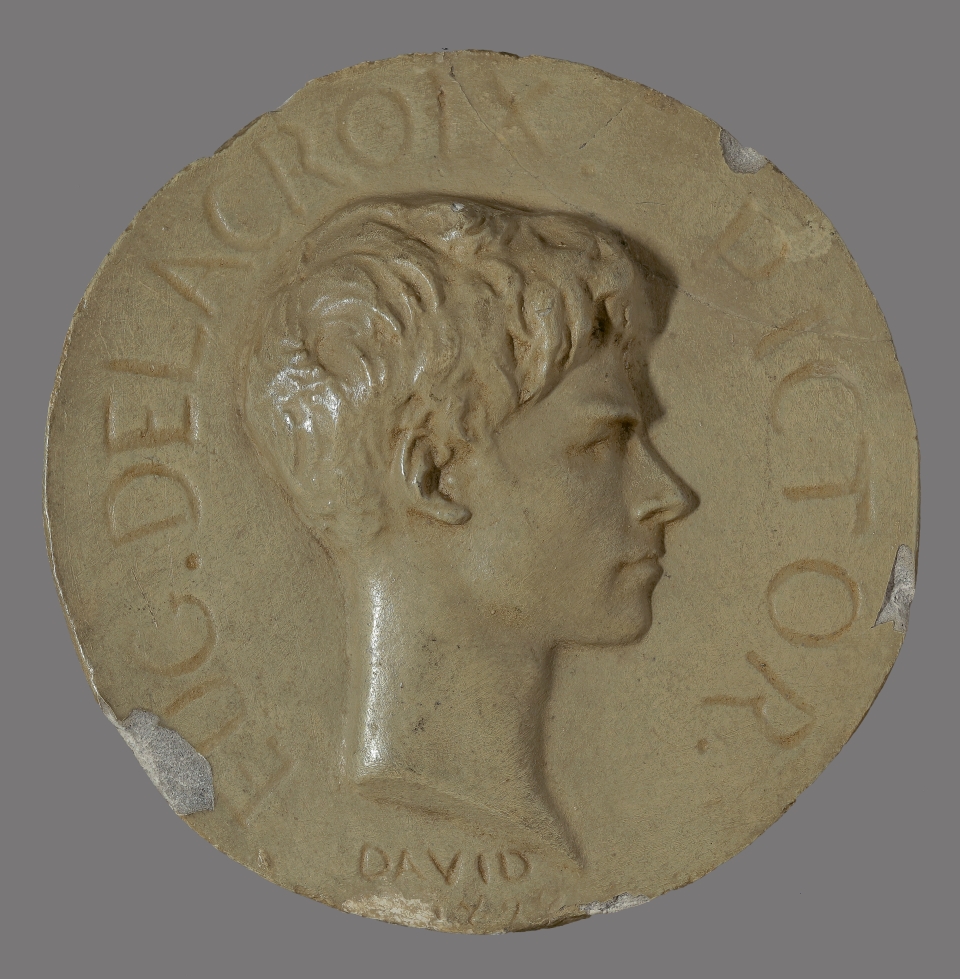
David d'Angers presented Goethe three medallions in Weimar to convince him of his idea and his abilities - with success! One of these included a portrait of Eugène Delacroix [4].
In 1827, Delacroix created 17 lithographs for the luxurious edition of the French translation of Faust I (1828). Goethe reviewed them in the art criticism and cultural policy magazine Ueber Kunst und Alterthum. He described him as a “painter of undeniable talent” and concluded:
“But one thing is particularly strange, that these artist has taken this work so much to heart that he has interpreted all its original darkness in the same way, portraying a restless hero with the same restless burin.”
—
Goethe was deeply interested in the poet Lord Byron. Conversely, Byron referred to Goethe's Faust I in his Manfred and Sardanapalus.
In November 1822, Goethe received a handwritten dedication from Byron: “Dedication of "Sardanapalus" / To the illustrious Goethe a / stranger presumes to offer the / homage of a literary vassal to / his liege =Lord.” Goethe thanked him in 1823 with the poem Ein freundlich Wort kommt eines nach dem anderen. This sealed a vow of fidelity between the German and English poets. Unfortunately, a face-to-face meeting was never to happen.