Display case 2: The story behind its development
The medallions [4–11] belonged to the architect Clemens Courday, who obtained them from Goethe's collection [12] in 1830. In January 1931, director Ernst Beutler was given 29 of these medallions as a present for the Freies Deutsches Hochstift.
The owners are listed in the following order:
Clemens Wenzeslaus Coudray, Weimar (1775–1845); his daughter Marie Neher, born Coudray (1812–1893) and her husband, historical painter Bernhard Neher (1806–1886); their son, Frankfurt building officer Ludwig Neher (1850–1916); bequest of his wife Ida Neher, born Passavant (1859–1930).
—
Coudray worked as Grand Ducal Chief Architect in Weimar from 1816 onwards and had a decisive influence on the cityscape. His works include the city tower of the Herzogin Anna Amalia Bibliothek and the Neue Wache.
Goethe commissioned Coudray to arrange David d'Angers' marble bust. This resulted in direct communication between the architect and the sculptor. At the same time, Goethe himself circulated David d'Angers' gypsum medallions. In March 1830, he wrote passionately to him: “Let me say [...] without exaggeration: your important sending has truly made an epoch in my home and circle of friends, doubly and triply gratifying. Goethe was fascinated by the fact that the medallions presented him with images of individuals whose characters he could now compare with their works and deeds.
Coudray wirkte ab 1816 als Großherzoglicher Oberbaudirektor in Weimar und prägte maßgeblich das Stadtbild. Zu seinen Werken zählen der Stadtturm der Herzogin Anna Amalia Bibliothek und die Neue Wache.
Goethe betraute Coudray mit der angemessenen Aufstellung der Marmorbüste. Damit standen der Architekt und der Bildhauer im direkten Austausch. Zugleich brachte Goethe selbst die Gipsmedaillons von David d’Angers in Umlauf. Im März 1830 schrieb er diesem leidenschaftlich: „Lassen Sie mich [...] ohne Übertreibung sagen: daß Ihre wichtige Sendung wahrhaft Epoche in meinem häuslichen und Freundes-Kreise gemacht hat, doppelt und dreyfach erfreulich“. Goethe faszinierte, dass die Medaillons ihm Individuen vor Augen stellten, deren Gestalt er nun mit ihren Werken und Taten vergleichen könnte.
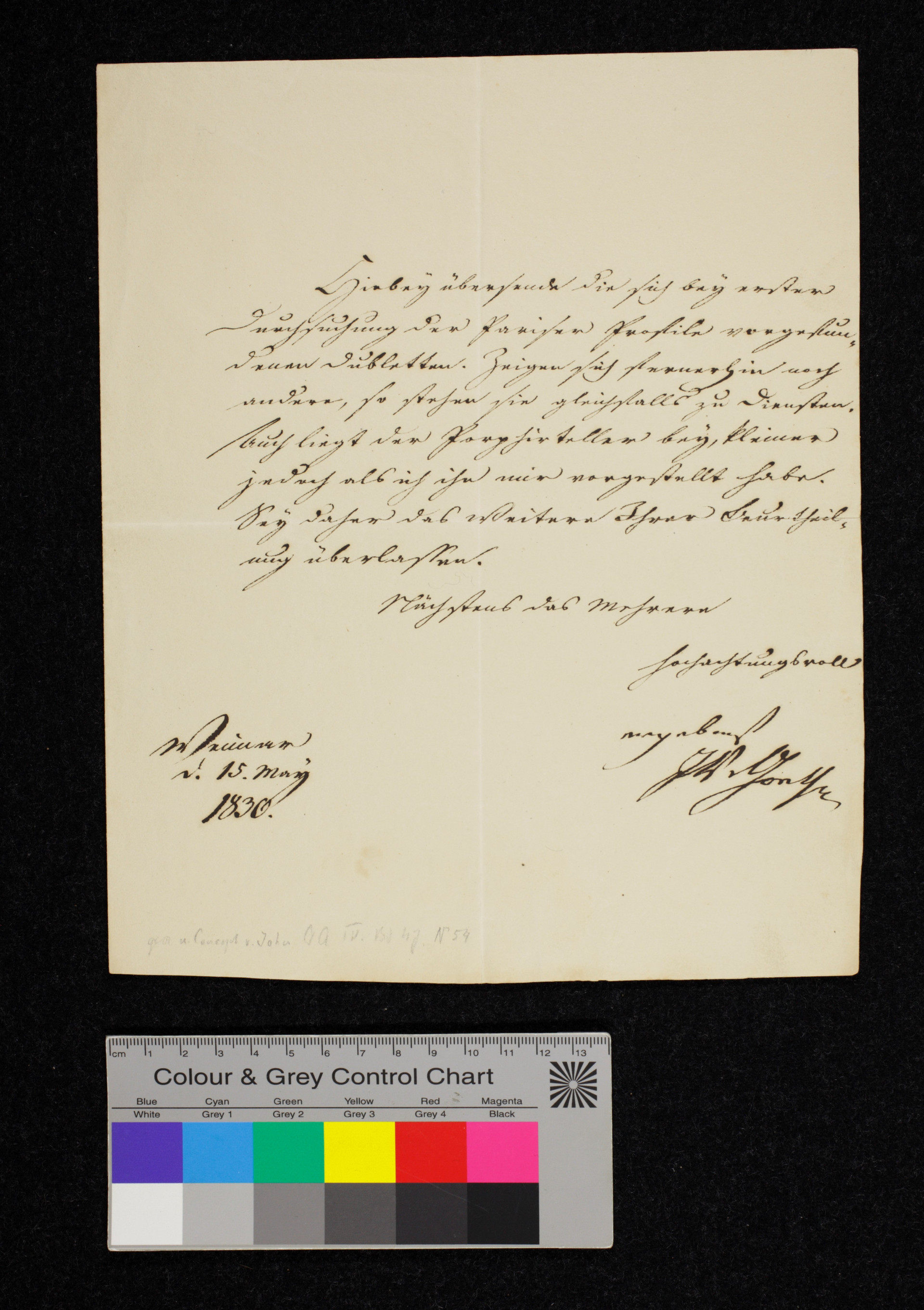
Transcription Goethe to Coudray in May 15, 1830 [12]:
Hierbey übersende die sich bey erster
Durchsichtung der Pariser Profile vorgefunden
denen Dublettten. Zeigen sich fernerhin noch
andere, so stehen sie gleichfalls zu diensten.
Auch liegt der Porphyrteller bey, kleiner
jedoch als ich ihn mir vorgestellt habe.
Sey daher das Weitere Ihrer Beurtheil
ung überlassen.
Nächstens das Mehrere
hochachtungsvoll
Weimar ergebend
d. 15. May JW vGoethe
1830